
c2e.
i've heard it all before, splashville. good luck, though.


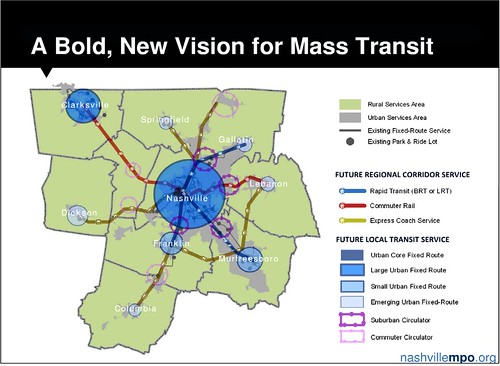
The regional planning authority for the Nashville, Tennessee, metropolitan area has embarked on a new philosophy to put the notoriously sprawling region on a less polluting and less consumptive path, anchored by walkable neighborhoods, public transportation and maximizing the efficiency of current roadways.
Meeting the laudable goal of shaping a more sustainable region will not be easy: in 2001, the Nashville metro area was cited as the nation’s most spread-out – the area with the fewest number of residents per square mile – in a review of 271 of our largest metro areas.
If Nashville’s land use challenge is daunting, its transportation challenges – in large part created by the predominance of sprawl – are similarly formidable. (via)
The Pruitt-Igoe housing project in St. Louis became most famous at the moment of its demise. The thirty-three high-rise towers built in the 1950’s were supposed to solve the impending population crisis in inner city St. Louis. It was supposed to save the urban poor from the indignities of the downtown slums that lacked natural light, water and fresh air. And for a short while, it worked. It was a housing marvel.
But when conditions started to decline, everything got very bad, very fast. It got so bad, only two decades after it was built; the housing authority blew it up. The image of the first Pruitt-Igoe controlled implosion circled the globe. The implosion footage became the unassailable proof that Modernist architecture and federal housing just didn’t work. Chad Freidrichs is the director of the new documentary The Pruitt-Igoe Myth and in the film he examines all the reasons people cite for the demise of Pruitt-Igoe. (via)that looks real good.

As the critic Lewis Mumford wrote half a century ago, “The right to have access to every building in the city by private motorcar in an age when everyone possesses such a vehicle is the right to destroy the city.” Yet we continue to produce parking lots, in cities as well as in suburbs, in the same way we consume all those billions of plastic bottles of water and disposable diapers.
What to do?
For starters we ought to take these lots more seriously, architecturally. Many architects and urban planners don’t. Beyond greener designs and the occasional celebrity-architect garage, we need to think more about these lots as public spaces, as part of the infrastructure of our streets and sidewalks, places for various activities that may change and evolve, because not all good architecture is permanent. (via)

Medellin, Colombia was once known as one of the world's most violent cities. It was the center of a major drug cartel, which actually took its name from the city. Now Medellin is enjoying the spotlight for a new socially-conscious public transportation system.
To understand this story you need to know that Medellin is in a valley surrounded by incredibly beautiful green mountains, which have also become the location of many neighborhoods on the steep mountainsides.
And yesterday, Medellin's mayor inaugurated a giant outdoor escalator. It was built for residents of one of the city's poorest districts, with the aim of better integrating them into the city and the broader economy.
The slum is located on one of those hillsides, and its residents have long had to climb hundreds of steps - the equivalent of a 28-story building - to get home from work. Now they can stand and be transported on their new 1,200-foot moving walkway that turns a 35-minute haul into a six-minute commute. The project cost about $7 million. (via)

According to The Wall Street Journal and The New York Times, New York Mayor Michael Bloomberg will announce today that Cornell University has won the city's competition to open a new technology-based campus on Roosevelt Island. The facility will be a 2,000-student satellite campus of Cornell, based out of Ithaca in upstate New York, focusing on high-tech studies in order to turn city into an East Coast startup hub akin to Stanford-Silicon Valley pairing out west. The move to the Big Apple isn't unprecedented for Cornell, which already has its medical school in the city. (via)


 the wall street journal is here to brighten your day with two really uplifting articles. one is about how the american dream as we know it is dead....and the other is about how america's ten fastest dying cities (sorry, ohio) are getting together to talk about saving themselves.
 Nicolai Ouroussoff studies 4 cities (New Orleans, LA, the Bronx, and Buffalo) in an interesting piece about urban development:
 PARIS — Hand it to the French. Who else would pick an economic collapse as a time to unveil one of the most audacious urban plans in recent memory? (nytimes)


